

Written by Roopa Palanivel
February 2026 · 5 minutes
Zigmee Lepcha and his family in Tingvong village of Dzongu Valley start and end their day with Ma Kanchenjunga. In the morning, they burn juniper twigs as incense and pray to the mountain. They repeat this ritual in the evening.

View from the homestay in Tingvong village of Dzongu Valley, Sikkim. Photograph by Nitesh Kumar.
Kanchenjunga, also known as Khangchendzonga, lies on the border between Nepal and Sikkim. Standing at 8,586 metres, it’s far more than the world’s third-highest peak. It is a part of the Lepchas’ cultural identity, origin stories and spiritual beliefs.
There is a simplicity to the way they worship the mountain, yet a profound sense of devotion. “Every morning, we take Ma Kanchenjunga’s name, we see her, we think about her in our minds, and then only we start our day,” says Zigmee Lepcha.
Staying with a Lepcha family brings you close to this sacred mountain. Imagine waking up to Kanchenjunga gradually revealing itself as the sun rises. The snow-covered peaks take on shades of pink and gold, while the valleys below remain in shadow. As the light spreads, the mountain turns a brilliant white, towering over the forested slopes and terraced fields. For many who are part of the Unexplored Sikkim program, catching this dramatic scenery on a clear day is an unforgettable experience.

Unexplorers standing in front of the Kanchenjunga mountain range in Fambong Lho Wildlife Sanctuary. Photography by Abhishek Tiwari
“Every day Unexplorers would wake up early just to see Kanchenjunga glow in the sun. It’s something they wait for throughout the trip,” says Nitesh Kumar, Experience Designer for Unexplored India.
The morning unfolds as it always has for the Lepchas. The village comes alive, smoke rises from the kitchens, and people begin preparing for their day’s work in the fields. Kanchenjunga watches over them quietly, a constant, unwavering presence in their lives.
Being among the mountains can inspire a sense of awe, making us feel part of something much bigger than ourselves. For the Lepchas, the relationship goes beyond awe. It’s one of kinship, belonging and a deep spiritual connection. The landscape is closely tied to their stories of creation, the way they live and their beliefs about the afterlife.

Kanchenjunga mountain range viewed from the Fambong Lho Wildlife Sanctuary in Sikkim. Photograph by Abhishek Tiwari
According to Lepcha mythology, Kanchenjunga, known as Kongchen Kongchlo, was the very first creation of Itbu-moo, the Mother Creator. She then shaped the first man, Fudongthing, and woman, Nazong Nyu, from its snows. The Lepchas call themselves Mutanchi Rongkup Rumkup, commonly translated as ‘children of the snowy peaks’ or ‘beloved children of the Mother Creator’. To them, the mountain is a guardian and is sometimes regarded as an elder brother.
“What I have noticed is that in some places in Sikkim they refer to Kanchenjunga as Ma, especially in Dzongu Valley, but in other places they refer to it as Lord or deity and say He,” explains Nalin Ranjan, Experience Lead for the Unexplored Sikkim program.
The mountain is also considered the gateway to Mayel Lyang, a hidden paradise and the sacred ancestral land of the Lepcha people. Some accounts describe it as a real place on the slopes of Kanchenjunga and others as a spiritual homeland to which the souls of the dead return. One story describes the mountain rising from a vast expanse of primordial water to guard Mayel Lyang.
Lepcha ritual specialists known as Bongthings and Muns perform traditional ceremonies to honour the spirits linked to Kanchenjunga and the wider landscape. Through prayers, offerings and dance, some of these rites seek blessings for the well-being of the community and protection of their land.
You can’t explore Dzongu Valley in North Sikkim without permits. Bordered by the Teesta River in the southeast and the Kanchenjunga mountain range in the west, the region is a designated reserve for the Lepcha community. It lies within the wider landscape of the Khangchendzonga Biosphere Reserve, which includes the Khangchendzonga National Park and surrounding buffer and transition zones. The region isn’t just home for the Lepchas. In their beliefs and folklore, Dzongu’s landscape is a bridge to Mayel Lyang.

Teesta river flowing in Dzongu Valley, Sikkim. Photography by Nitesh Kumar
While designing the Unexplored Sikkim program, Nitesh travelled to Dzongu Valley by motorbike. He navigated bumpy stretches of road alongside the Teesta River, crossed hanging bridges and passed through small villages along the way.
Nitesh met Zigmee Anum (Anum means 'brother 'in the Lepcha language) in Tingvong village. His family has lived in Dzongu Valley since the time of the Chogyal dynasty. His great grandfather served as a mandal or revenue collector during that period. His grandfather’s brother, Loden Tshering Lepcha, was the first MLA of Dzongu Valley. Zigmee Anum is concerned that a lot of young Lepchas are leaving their villages to study and work in bigger towns. While modernisation is changing certain aspects of the Lepcha way of life, their connection to nature remains strong.
Today, his homestay in Upper Dzongu Valley helps Unexplorers understand Lepcha traditions and their way of life.
“In Upper Dzongu there are about 15-20 villages. Almost every village has a view of Mount Kanchenjunga. It’s considered a blessing to the Lepcha people to be able to see their deity every day,” says Nitesh.
Kanchenjunga doesn’t just dominate Sikkim’s Himalayan skyline; it’s a spiritual anchor for different traditions and ethnicities. Just as the Lepchas speak of Mayel Lyang, Sikkimese Buddhists associate the mountain with Beyul Demajong, a sacred, hidden land. They also see it as the home of Dzonga, a powerful guardian deity who safeguards the land and its people.
This belief is reflected at Enchey Monastery in Gangtok, where Dzonga and another protective deity, Yabdean, are said to reside. According to legend, Guru Padmasambhava, also known as Guru Rinpoche, subdued their spirits at this site and bound them to protect Buddhism and the sacred land.
Dzonga is also honoured across Sikkim every year at Pang Lhabsol, held around late August or early September. A celebration of brotherhood, the festival reflects the shared history of Lepcha and Sikkimese Bhutia religious traditions. It pays homage to a historic pact made centuries ago between Thekong Tek, a Lepcha leader, and Khye Bumsa, an ancestor of the Namgyal dynasty. It is said that Kanchenjunga and other local deities were witnesses.
Pang Lhabsol brings this story to life through a masked warrior dance called the Pangtoed Cham. During the performance, Dzonga is represented by a dancer wearing a deep red mask. The dance is believed to have been introduced by Sikkim’s third Chogyal, Chakdor Namgyal, after he saw it in a vision.
Although Sikkim is India’s least populous state, it has several distinct languages, traditions, and histories. Pang Lhabsol is a reminder that Kanchenjunga belongs to everyone in Sikkim, not just one community. The mountain remains a powerful symbol of Sikkimese identity, uniting people through a shared reverence.
Climbing a mountain is often seen as a physical and mental challenge. For many, reaching the summit is a significant personal achievement, and rightly so. Not every mountain needs to be climbed to be understood. Being in the presence of Kanchenjunga, even at a distance, and seeing it through the eyes of the indigenous communities offers a different perspective.
According to the Lepchas and Bhutias, stepping on Kanchenjunga’s summit is disrespectful to the sacred spirits that reside there. Climbing the mountain from the Indian side has been banned since 2001. Although it can still be climbed from Nepal, the issue remains debated in the mountaineering world. This isn’t new. During the first ascent of Kanchenjunga in 1955, British climbers deliberately stopped short of the summit to honour a promise made to Sikkim’s Chogyal to leave it untouched.
On a clear day, Kanchenjunga can be seen from various points during the Unexplored Sikkim program. From Gangtok, you get glimpses of it, while Fambong Lho Wildlife Sanctuary offers a panoramic view of the mountain range. From Tingvong village, you can see Mount Pandim alongside Kanchenjunga.
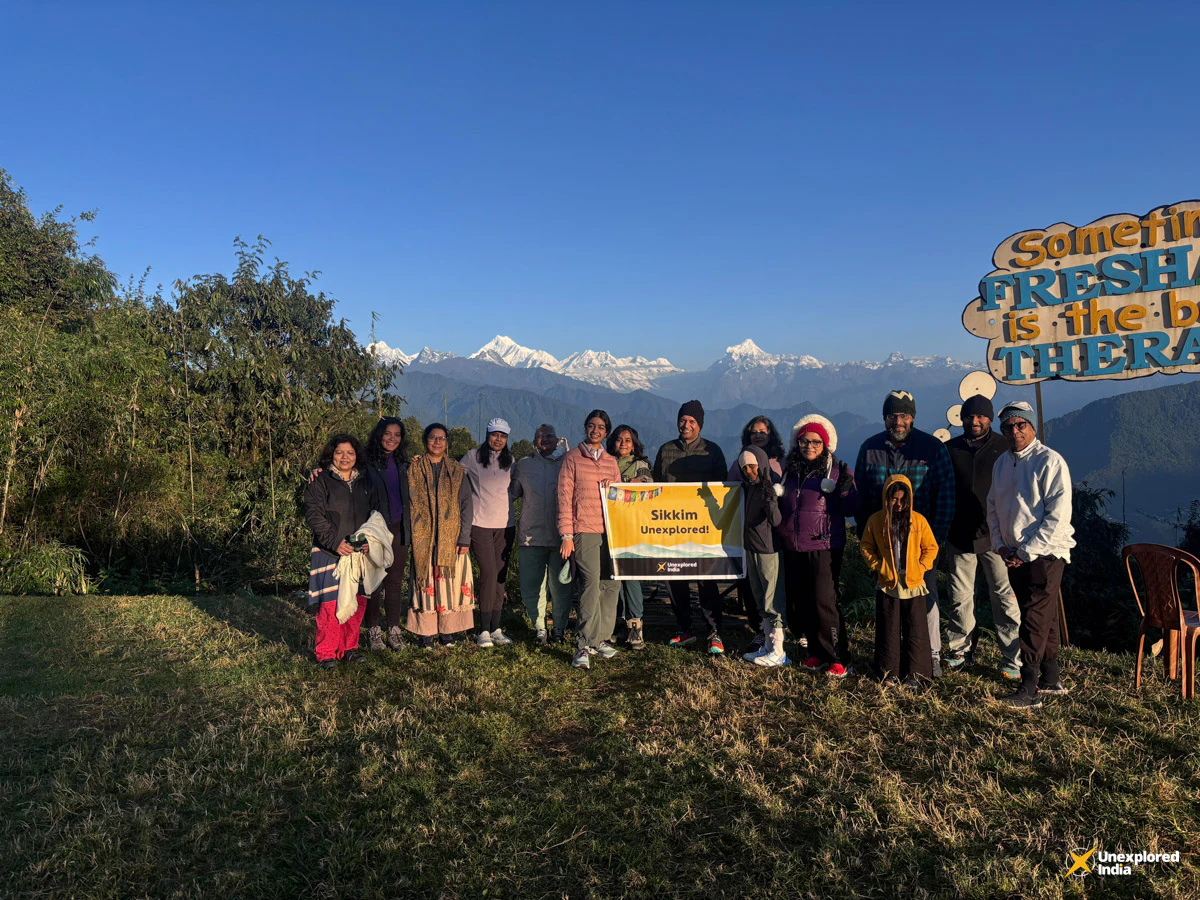
Unexplorers after completing the Unexplored Sikkim Program. Photograph by Nalin Ranjan
Beyond these views, spending time with the Lepchas reminds us that this mighty peak is part of a larger cultural landscape. While, as travellers, we may not worship Kanchenjunga, we can still understand what it means to the people who have lived in its presence for generations.
Roopa Palanivel
Roopa is a writer and yoga teacher based in Coorg. Before becoming a yoga teacher, she was the copywriting head at HCL Technologies and a senior communications consultant for a marketing services firm, working on content across industries. Originally from Chennai, she moved to Coorg to live a quieter, slower life. She enjoys trekking, running and travelling with her husband and dog.